First appeared on: Kimly Construction Pte Ltd
Related articles about Doxa & Kimly: UOB, Doxa sign MOU to digitalise Kimly Construction’s finance processes
Collaboration Among Stakeholders Can Simplify Decarbonisation in the Construction Sector
The Supply Chain Subcontractors Need to Understand the Advantages of Green Building Techniques and Materials
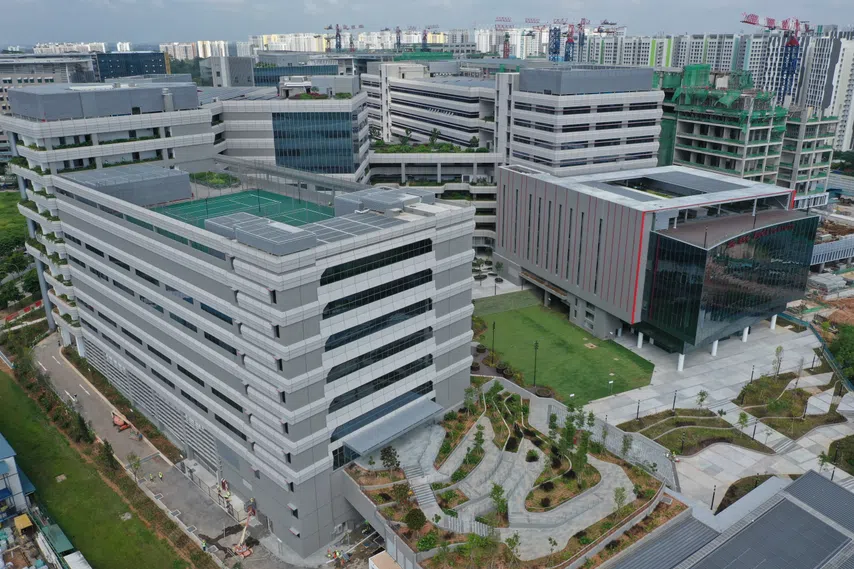
The Singapore Institute of Technology’s (SIT) Campus Court, which is slated to open this year, involved more than 150 subcontractors and suppliers.
Kimly Construction’s director, Louis Khoo, pointed out that this large number of stakeholders is common in many projects, and it adds complexity to the goal of reducing the carbon footprint of the built environment industry. The SIT Campus Court project, located in JTC’s Punggol Digital District, is anticipated to span an area of 4.2 hectares and include six buildings.
The entire site has received the Green Mark Platinum certification from the Building and Construction Authority, and two of its buildings have been awarded the “super low energy” designation. To earn the super low energy status, buildings must show at least 60% energy savings compared to a 2005 benchmark.
Campus Court exemplifies the kind of building projects that are urgently needed in an industry that is responsible for nearly 40% of global greenhouse gas emissions. According to the Singapore Green Building Council, embodied carbon emissions, which are the carbon emissions from the supply chain of materials and systems used in any built environment project, make up about 30% of a building’s total emissions. The remaining 70% comes from the building’s operations.
Due to Singapore’s rapid urban renewal cycle, many of its buildings have shorter lifespans. This means that embodied carbon can account for 40% of the total carbon emissions over a building’s lifespan. Industry players are striving to make their buildings greener. Khoo mentioned that Kimly’s clients are requesting presentations and reports on its sustainability practices and goals. He predicted that in the next three to five years, this could become standard practice, with demand coming from both the government and private developers. However, meeting this demand can be challenging. The large number of participants in a project can make it hard to monitor every stakeholder’s decarbonisation efforts, particularly as many subcontractors also hire their own subcontractors.
All subcontractors in the supply chain need to be persuaded of the benefits of green building methods and materials, and they must be willing to work together to achieve certain objectives. To support its own green journey, Kimly is working with those subcontractors that are more progressive and receptive to greener building methods. The company identifies these progressive companies through schemes such as the Green and Gracious Builder Scheme (GGBS), which certifies and categorises companies based on several factors.
Among the environmental factors used, for instance, are the amount of concrete and rebar wastage for a company’s recently completed projects, as well as its energy and water usage. Kimly Construction itself has achieved the highest “Star” categorisation as at Dec 31, 2023. To achieve this, the company has adopted various measures to reduce its energy consumption and carbon footprint. For instance, the company has adopted a battery energy storage system to replace diesel-powered generators. This has led to savings of more than S$17,000 in operating expenditure per year and a reduction in carbon dioxide emissions by 53 per cent, or over 200 tonnes.
The company has adopted solar panels to power low-powered equipment such as noise metres and traffic warning signs. At the company’s innovation hub in Tuas South, Kimly has installed a 994-kilowatt-peak solar panel system on the roof to offset some of its energy consumption.
“It also helps to save our costs; because with solar power, the energy cost is lower as well,” Khoo said.
Green Technology towards Sustainability Goals
Kimly is also using technology to optimise certain aspects of its operations and achieve certain green goals.
For the past three years, Kimly has been using a digital payments platform called Doxa Connex to track what it receives and pays out to subcontractors and suppliers. In the past, it was difficult to keep track of the numerous purchase orders and invoices sent and received by subcontractors and suppliers over emails. With the digital platform, Kimly is able to create clear audit trails for which funds are spent on which products.
“In order to be classified as green financing, (funds) need to go to green products.
“If it’s out of the system, it’s more difficult to validate the integrity of the data,” he said.
Usage of the digital platform was one of the criteria that the company needed in order to qualify for UOB’s green trade project financing. In August 2022, the bank signed a memorandum of understanding with Doxa and Kimly Construction to execute the trio’s first green trade finance transaction together.
Green features of SIT Campus Court
The package granted Kimly with overdraft and invoice financing lines based on the cash flow projections of their requirements to support the SIT project, which achieves the Green Mark Platinum certification.
“The overdraft and trade limit is implemented according to Kimly’s requirements throughout the project, and progress is monitored continuously to ensure it aligns with initial projection, with amendments made where necessary during periodic reviews,” a UOB spokesperson said.
Khoo said Kimly’s subcontractors also like the platform because Kimly foots the bill for its usage, and the subcontractors are paid more quickly as the approval process is more efficient.
He said it also helps that UOB, which has a long history and a sprawling network within the construction industry, is pushing for the adoption of such digital platforms.
“They can help to push for the (solution to) scale up. If there’s economies of scale then… we can build an ecosystem where, actually the benefits are better,” he said.
Financial institutions will play an important role in the adoption of green standards and operations in the built environment sector.
Khoo expects projects that are not green-certified to face greater challenges securing financial support from banks.
This means green considerations will become especially important for building owners, because they are still largely responsible for specifying and fitting their buildings out with green technologies.
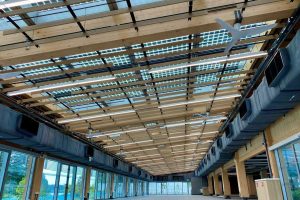
The food court at SIT Campus Court site is equipped with a Building Integrated Photovoltaic (BIPV) roof that generates renewable energy for power.
PHOTO: KIMLY CONSTRUCTION
An example of such technologies being adopted at the SIT Campus Court site is the use of building-integrated photovoltaic glass modules. These modules allow natural light into areas such as the food court, while generating energy solar power as well.
UOB Green Financing
UOB provided Kimly with a green trade project financing package that gave Kimly Construction access to overdraft and invoice financing lines based on their cash flow projections. This is meant to support the SIT project, which has features that adhere to the BCA Green Mark Platinum standard.
The package caters to Kimly’s working capital needs during each stage of the construction process, and includes the issuance of a Banker’s Guarantee as required by SIT.
UOB head of group commercial banking Eric Lian said: “As part of our commitment towards fostering sustainable growth across industries, we partner progressive companies like Kimly Construction that embrace innovation and efficiency, including the adoption of advanced technologies and sustainable solutions in their projects.”
“Our suite of sustainable financing solutions helps businesses simplify and integrate sustainability into their business strategies towards a more resilient future,” he added.
UOB also monitors the project continuously to ensure that it aligns to its initial projections as the overdraft and trade limits are implemented according to Kimly’s requirements throughout the project. Amendments are made where necessary during periodic reviews.
For more insights, read the full article in The Business Times and ZaoBao or explore additional perspectives on UOB green financing here.
The original press release can be found here.
Also can be seen on: